We’re Having a Heat Wave

Who would have predicted a heat wave in Europe as I prep for my Camino de Santiago trip, but BBC reports of 113F in parts of Portugal got my attention. I’ve looked previously at temperature norms for the areas I’ll be walking through and have been looking forward to a range of low 50s to mid to high 70s. Yesterday it peaked at 99 in Pamplona!

This is when I become thankful I’m not walking now on the Camino. Most Futurecast predictions call for a return to normal temperatures in the weeks ahead, so hopefully my plan of escaping the dog days of Texas summer by spending late August and all of September in Spain will come to fruition.

I guess I’m more surprised there aren’t more heat waves across Europe. They say this latest is caused by heat off the Sahara blowing up over the European continent. And it’s not just this past week, either. A friend in Berlin has been posting about the abnormally hot summer they ae having, and I think parts of the UK are also baking. Welcome to global warming, I guess, where historical trends exist now for history’s sake rather than as tools for prediction.

Burgos to Astorga: Days 13-23

As I now begin to follow more closely weather across Northern Spain, I do see that there may be some hotter conditions as one crosses the “meseta” between Burgos and Astorga, a distance of 140 miles, or so, at an elevation just under 3000 feet. This semi-straddles the middle portion of the French Way of the Camino de Santiago. I’m lured by some of the descriptions I am reading of open space, certainly plenty of sky, but also varied agricultural usage. It sounds as though it might be the place to “be here now.”

All packing lists include gear that will allow the walker and his gear to stay dry, and those extended weather forecasts I’m seeing, showing encouraging temperatures, are also showing rain off and on through the weeks ahead. Of course, it’s still too early to see reliable forecasts for the first several legs of my 500 mile trek, but I’m glad to have a poncho which will serve double duty of sheltering both me and my backpack when the rains do fall. I have the greatest confidence in my new boots, advertised as waterproof, which usually means water resistant. I walked through a puddle yesterday and I’m here to proclaim my feet stayed dry. To further cover the bases, I took the advice of my friend Adrienne who swore by the Wrightsocks she wore on her recent trekking on the John Muir Trail. Yesterday I bought Wrightsocks at the wright time and for the wright price at REI. Here’s to dry and blister-free feet!
Countdown T-(less than) 3 Weeks

“Never put off until tomorrow what you can do the day after tomorrow.” Mark Twain

71jyCUgosLLWhere is the time going? This veteran procrastinator is beginning to feel a little pressed for what time remains before I find myself “leaving on a jet plane, don’t know when I’ll be back again.” Poetic, yes? But not quite true, for I do know when I’ll be back again. It’s just that right now my focus is on tying up loose ends so I can walk out the door with a clear and guilt-free mind. Don’t know about the guilt-free, though. I’ll probably drag some of that around, at least through the beginning of this adventure.
Well, that’s a load to digest. And I only intended to bring some things up to date in terms of the planning and logistics. When I began to line up all the proverbial ducks in a row, after locking in travel reservations, my thought was “I’ve got everything I need – backpack, hiking boots, any number of hats, depending how “cool” I want to be, hiking shorts, gobs of wicking style running shirts.” But then again . . .

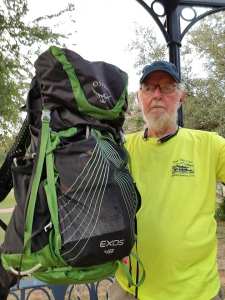
38433511_10155799949345829_612418527743180800_nOK. I’ll modernize the backpack, go ultra-light which is what so many have recommended. I hit the jackpot and found a nice Osprey bag nicely discounted as last year’s model. “Don’t overload it,” warned the sales lady at Whole Earth. “35 pounds is about the max.” Then I got hit with what seems to be the golden rule of packing for the Camino de Santiago. Carry no more than 10% of your body weight. No, more like: CARRY NO MORE THAN 10% . . ” Well, you get it. It’s too late for me to put on a hundred pounds or so, qualifying me to carry more stuff in my ultra-light backpack so I guess I better consider plans b, c, and d.
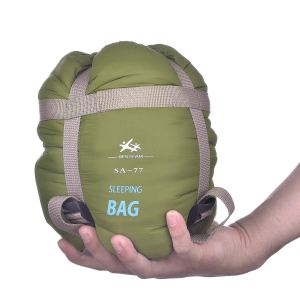
I’m a little stubborn at this point, sort of like never wanting to count calories. My brother Kenneth asked me how much I’m carrying in my pack on training walks. Good question, but I haven’t got a definitive answer since I’ve put off weighing anything or everything. 81geK+3IQLL._SL1500_What I do know is I have taken some things out of the pack, items previously considered essential. But now, in their place, other items are slipping past me, stowing away in the pack. I don’t need a sleeping bag, sort of a 50-50 consensus on that as I read the advice of those who have walked the Camino, but I just broke down and bought a quite cheap 2-season sleeping bag, nothing fancy at all, but it comes in at a pound and a half and compresses down to the size of a basketball.
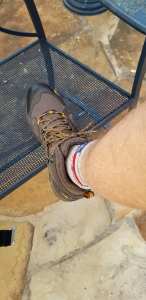
I’ve known all along that I would probably need to invest in some new shoes for these 500 miles looming on my horizon. My current North Face boots are showing some wear, and I’ve been indoctrinated by many years of sometimes serious running that at such and such mileage, you have to buy new shoes. I assume the formula is somewhat similar for hiking boots, though I don’t think I ever paid much attention to it with my first Vasque boots bought from the original Whole Earth Provision in Austin back in the late 60s. I just know I wore them into the ground and still wondered if it was worth having them resoled. That’s something we did back in those more frugal days. These days, in fact 38292844_10155799949300829_6753870394043662336_oonly a few days ago, I started the odometer running on a new pair of boots and so far these North Face boots feel pretty good on my feet. Whether the boots and my feet will have that same loving feeling a hundred miles into the Camino de Santiago, or not, only time will tell.

I guess it’s my nature that the more I feel I know about something the more I question that knowledge. These new boots are just what I need becomes were these the right boots? should I have gone with trail runners instead? And the latest – do I need trekking poles for this mega-trek. Everywhere I read, and every photo I see of walkers on the French Camino, tells me: how will you ever do this without a pair of poles? They’re on my shopping list, that and a few other things. Come on, time! Let’s move this along lest I be spent out by the time I walk out the door, ridden with guilt for spending too much or not enough.

Three weeks from today, I should have gained the elevation to cross over the Pyrenees and many of the unknowns will begin to be known. I guess that’s why we need adventure and, frankly, I can’t wait to get myself on the road.

Thanks for reading this blog. If you like, hit the subscription button near the top of the page.

Some Maps to Ponder

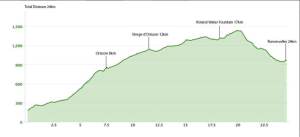
French route elevation profile

I love maps, and have been studying quite a few in preparation for my upcoming Camino. The above pretty much covers the ups and downs of those 500 miles, though all scrunched up so half a thousand miles will fit on the page. To give some perspective, the highest point on the trek falls at about the 2/3 mark of the journey with a double peak, one called Cruz de Ferro marked, as the name says, by a simple iron cross. This sits at 4,934 feet. The other twin of the two peaks is Altar Mayor at 4,970 feet. By the time I reach this highest reach of the walk, I will either be exhausted, or invigorated, more likely both.

Day 1bBut the very beginning of the so-called French Way will present an immediate challenge as the trail begins at around 656 feet, about the elevation of San Antonio, but then climbs over the first 12.5 miles to 4757 feet. Apparently, the weather can become quite variable, with rain, fog, and high winds presenting potential challenges. Should be interesting, to say the least. Santiago de Compostela or bust!
Frankly, I’m surprised my brother Kenneth and especially my sister Brenda have not suggested I skip that first leg of my journey. Years ago I became somewhat famously “lost” along the Continental Divide Trail, just below Colorado’s Monarch Pass. I had persuaded them to drop me off at the next pass south, Marshall Pass. I planned to hike and jog the 11 miles from Marshall to Monarch, this all at an elevation ranging from 10,834 to 11,970. I got a late start, then got lost when I got into snow up to mid-calf. Needless to say, neither Brenda nor Kenneth were too happy about my (mis)adventure but, hey, I lived to tell about it. Hopefully, I’ll be able to say the same about the 500 mile Camino de Santiago trek.


Camino de Santiago: What?

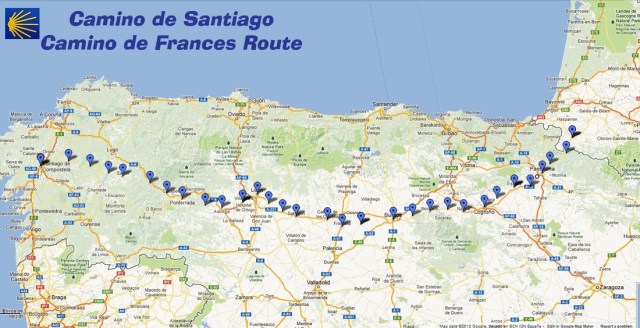
It occurs to me that some who begin reading, perhaps subscribing to this blog, are scratching their heads, wondering just what is the Camino de Santiago. It wasn’t all that long ago I would have been wondering myself. So for friends who would like to know more, here’s the short of it (if it’s possible to say that of an historic pilgrimage which can range from 60 miles to 500 miles to a trek of 1000 miles or more).

Cathedral Santiago de Compostela (photo credit: Vasco Roxo

Let’s work from the destination, Santiago de Compostela. This is a city in the northwest of Spain which is home to the grand Basilica de Santiago, part of the greater Santiago de Compostela World Heritage Site. The Cathedral, consecrated in 1211, is believed to contain the remains of Saint James, one of the original 12 apostles. Saint James, in the Spanish language, is Santiago.

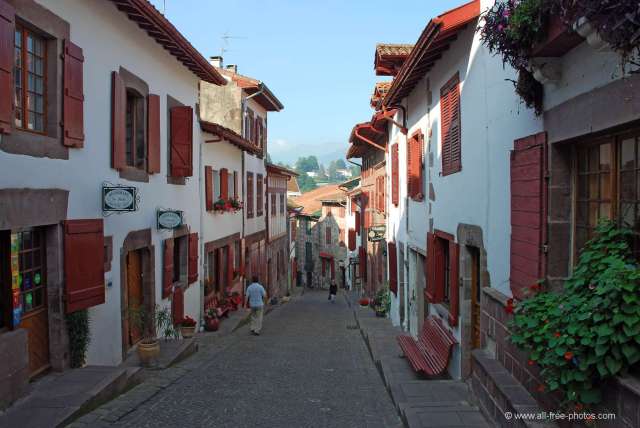
Scene from St. Jean Pied de Port, France. From here begins my Camino. (photo credit: http://www.all-free-photos.com


For over a thousand years, pilgrims have visited the site of St. James’ remains. These pilgrims have come from far and wide, thus there are a number of different routes to Santiago de Compostela. Undoubtedly, the most common route today begins in the French town of St. Jean Pied de Port, then crosses the Pyrenees through a pass said to have been used historically by Charlemagne and, later Napoleon, in their various incursions into the Iberian Peninsula.

The pilgrimage route which begins in St. Jean Pied de Port is commonly known as the French Route. Today it is suggested as a way divided into 33 legs, covering 491 miles. This is the adventure I am about to undertake, hoping to cover the entire distance in about 5 weeks, then perhaps walking further another 3 days to Finesterre (or Fisterre), at one time believed to be the end (fines) of the earth (terre).

Wish me luck, friends. If you want to follow along, you can subscribe to this blog. I hope to keep it updated as time and wifi allows.

The Camino Has Begun

July 20, 2018

Thank goodness I’m not boarding a plane right now for the physical start of 500 miles over 33 days of walking the famed Camino de Santiago. There’s still so much to do – get in shape, tie up loose ends to do with work and home, decide on gear and test such. The list goes on, even though I have yet to actually write that to-do list. But come midnight, the T-1 month countdown really starts.

This adventure has been on my mind since I followed on Facebook a friend’s camino last summer. A Camino de Santiago adventure, at best low on my bucket list, began to climb. Time’s running out is more likely an excuse than a reality, but it got my attention. Approaching my 70th birthday, I began to question how many landmark birthdays I might have. So far I’ve been pretty casual about the decade markers of 30-40-50-60- 63 got my attention when I passed my dad – but now 70! I’ve lived a longer life than any recent males on my father’s side. He died young, several of his brothers died even younger. I’m not so foolish as to regard myself as some kind of trailblazer. I’m happy to blaze that trail with my three younger siblings. We know life is precious, having lost a brother when he was in his 30s, and both parents gone some time ago. But does this make 70 that damned important?

Too many questions, mostly of no consequence, but the marker of 70 years has now taken on some importance. How to mark the passage in a way that’s out of the ordinary? Camino de Santiago began a climb near the top of the proverbial bucket list. I looked at projected costs. It seemed the proper thing to do, and in doing so I derailed the plan before it ever grew legs. A fare popped up in one night of browsing that startled me. It was something I felt my budget would bear. I tagged it, thinking I would take a day to confirm my sister could house and dog sit for me while I would be away. How long would this take? Could I get leave from my work at the radio station? Six weeks? No way! It all bogged down and then collapsed 12 hours later when I checked again the airfare. It had more than doubled – perhaps had never been more than illusion, or bait and switch.

The seed, deep in the back of my mind, needed encouragement to germinate. Every day or so, even after pretty much dismissing Camino de Santiago as a Don Quixotic dream, I would sneak a look at travel costs. They only climbed. But then one night, as I tried other itineraries, rather like trying a ring of keys, hoping to eventually open a lock, I found something affordable, that fit whatever my budget might be. I tried more keys and eventually found a now or never window of opportunity. I confirmed house sitter, dog sitter, bank balances. But could I get permission to fulfill my obligations to Texas Public Radio in absentia such that a six week absence wouldn’t waylay my plan. I sweated over it for half a day before I got the nudge to go ahead. But what about . . . ?

Another day, another look at an itinerary and a somewhat complicated mix of different airports, three different airlines, and I was a bundle of nerves. Bang! I pulled the trigger or, less dramatically, began the maze of mouse clicks to lock things in place. With the final clicks of each negotiation I could almost hear the air rushing into the space where once the dollars had been in my bank. Ready or not, the adventure has been loosed.

The Significance of Images

This blog is a work in progress and may change markedly as I find my way. I started out on Tumblr but have now migrated to WordPress which all the cool people use. I’m still monkeying around with the appearance so some of the references below are to images which have not yet made it over to the WordPress layout. In particular, this:

cropped-dscn5018

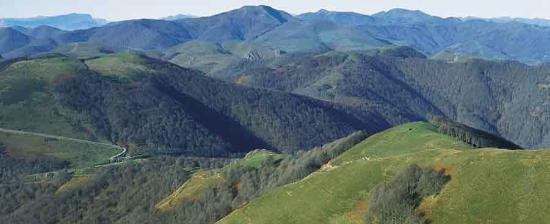
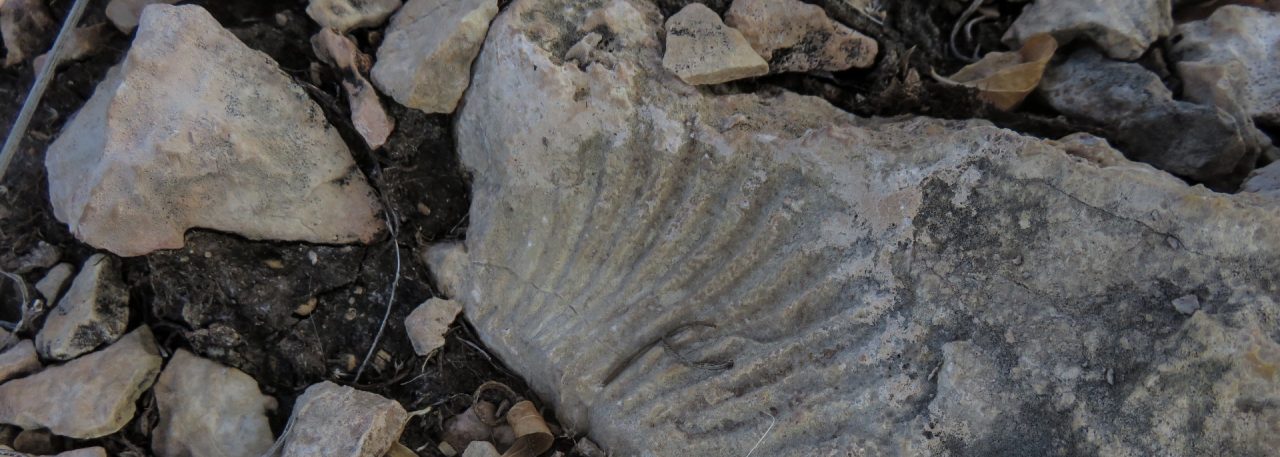
The two pictures you see (or I hope you see!) are my way of binding where I’m coming from to where I will go on the Camino. The edge to edge photo banner is a picture I took last December in Sanderson, TX, and shows a fossilized impression of a shell. This echoes the symbolic marking of the way along the Spanish parts of Camino de Santiago. The path is marked by stylized scallop shells, a practical way to show the way. Some believe that it is also symbolic of the shells found along the Galician coastline, another three days’ walk from Santiago de Compostela. According to other accounts, the earliest pilgrims would carry a shell as a practical vessel from which to eat or drink. Finally, and certainly appealing, is the thought that the lines of the scallop shell all converge, as pilgrims from many origins converge at Santiago de Compostela. Many pilgrims today carry a shell as a symbol of their journey and I will likely do so as well.

I’m still examining the multiple reasons I believe I have chosen to walk the Camino de Santiago. There’s the challenge, but also the possibilities which lie along the way. I am not a religious person, but am moved by the music of Bach, or Palestrina, or the Masses of Mozart and Haydn. I’ve no doubt the off-stage horn signals in Gustav Mahler’s Resurrection Symphony represent the voice of God, and I know that I am always touched from beyond when I hear (and have many times played) those calls. But please don’t insist this proves I am religious. Call it spiritual, if you must call it anything.

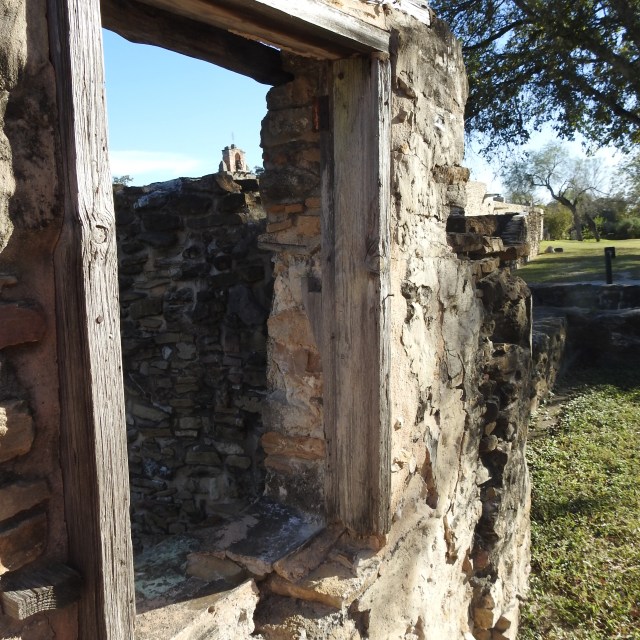
The inset photo was taken through a window at Mission Espada, one of the five missions along the San Antonio River. I wonder how many of the missionaries who came to San Antonio from Spain, by way of New Spain (Mexico) might have walked the Camino de Santiago? But I suppose the reason I have used this particular picture, symbolically, is the passage which is suggested by a door, or the flight of imagination suggested by a window.

I am cautious about imposing expectations on my Camino. The pictures at the top of this blog may be meaningless by the time I walk the first mile. But there’s also the perhaps that I will find answers along the way, though I’m not sure of the questions. As I told one friend, I am prepared to accept whatever the Camino might offer.

Camino Gear: The Art of Packing Light

Full disclaimer: I’ve never backpacked for more than a few days at a time, and I have always ended up with more gear in my backpack than I probably needed. The overpacking thing is a hard habit to break, but faced with 500 miles in about 5 weeks’ time I’m doing a lot of rethinking.

I assumed when I closed in on walking the Camino de Santiago, going the so-called French route from St. Jean Pied de Port to Santiago de Compostela, 500 miles (pardon the repetition of 500, that’s 500 miles, but I’m still working to convince myself that’s no typo, but reality), I would put my Kelty expedition style pack to work. I’ve been proud of that pack since I bought it years ago, but I’ve never really put it through its paces. Sure looks cool, though. I blew the dust off old Kelty, unloaded camping stuff packed inside, and began trying to imagine what I might need to carry on the Camino. Josu, in Spain, whose advice I have solicited, took a look at a picture I posted and wrote me that he thought that was too much, that’s without even asking how much “stuff” was in there and how much it weighed.

Josu’s concern reinforced the advice I’ve been seeing posted on the internet, or in the book, “A Pilgrim’s Guide to the Camino de Santiago.” But . . . but, I thought, I need to be allowed a few more things – a camera, an audio recorder, a camcorder, and some sort of device for blogging out my experiences to the curious (many just wondering, secretly, if I’ll even make it over the Pyrenees pass on day one). It’s true. I do need a few things beyond a pilgrim’s bare essentials.

Excuse me, Kelty, but you’re about to be demoted. A new brand of backback, new to me but maybe around for some time already, called Osprey, has caught my attention. Someone nominated it for consideration in an online packing list, along with $24 underwear, and I swallowed both links to see what the fuss was about. Osprey, apparently, is a leader in the field of minimalist backpacking. The argument, as applied to walking the Camino, is that 30-35 pounds of stuff is probably the max. Some will recommend carrying a sleeping bag, others don’t. The hostels and albergues are spaced out such that a bed should be available at the end of each of the 33 legs of the journey. I’m still out on whether I will carry a sleeping bag, or not, but for now that’s just a distraction.

I browsed backpacks at REI, looking for sales, and found none. However, I found what looks like a great price on last year’s model of one of the Osprey ultralights at Whole Earth and spent time as well getting advice from the woman who was overseeing that part of the store. I rarely solicit advice, so maybe the tide is beginning to turn, thanks to Glynda at WE and Josu, plus some other folks I will be talking to in the week’s ahead. Glynda sized me up and determined I needed the “large” version of the Osprey Exos 48, which unfortunately they did not have in stock. However, the good news is one of the Austin stores is sending one over for me to try. My fingers are crossed that it will be adequate for my needs.

Meanwhile, I’m field testing a pair of $24 boxers, promoted as comfortable and fast drying. The recommendations say you only need two pair for a thirty day journey. Pack light, they say!